

FIFO method: the controlled rotation that eliminates your losses
A pallet sleeping for 6 months while another, more recent one goes into production. An expired lot discovered too late. Aged components mixed with new ones. FIFO (first in, first out) wipes out these drifts with a simple discipline - but one that demands the right physical supports.
FIFO or LIFO: the rule that determines your losses
Every storage area follows one of these two rules, knowingly or by default. Understanding the difference and choosing the right one is the first step toward healthy stock management.
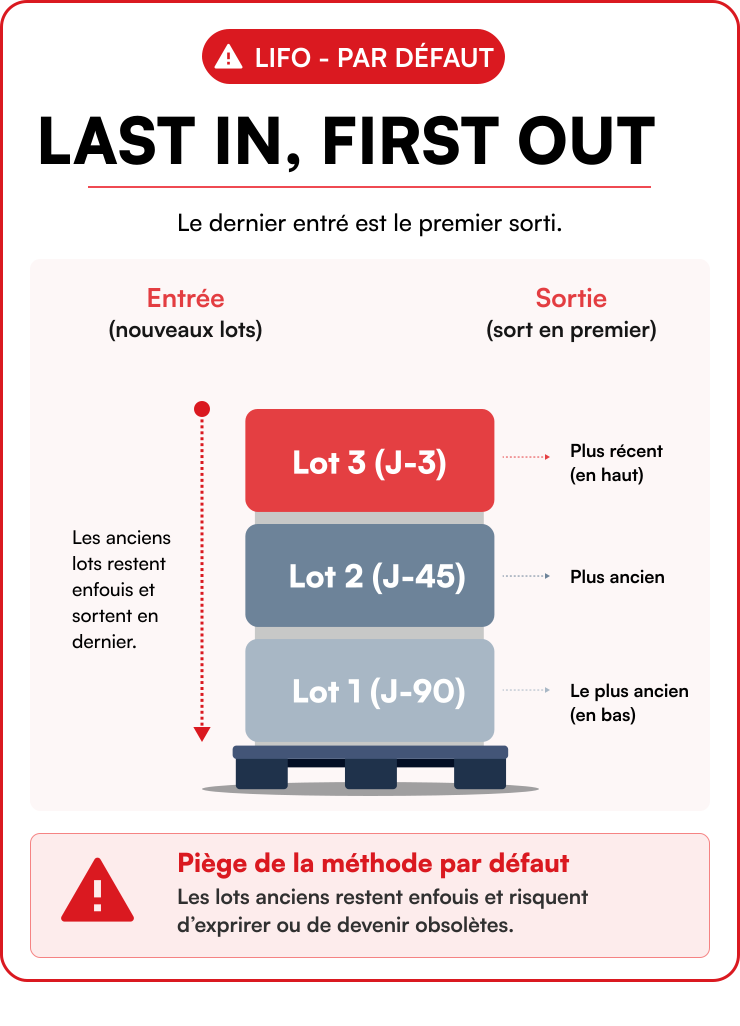
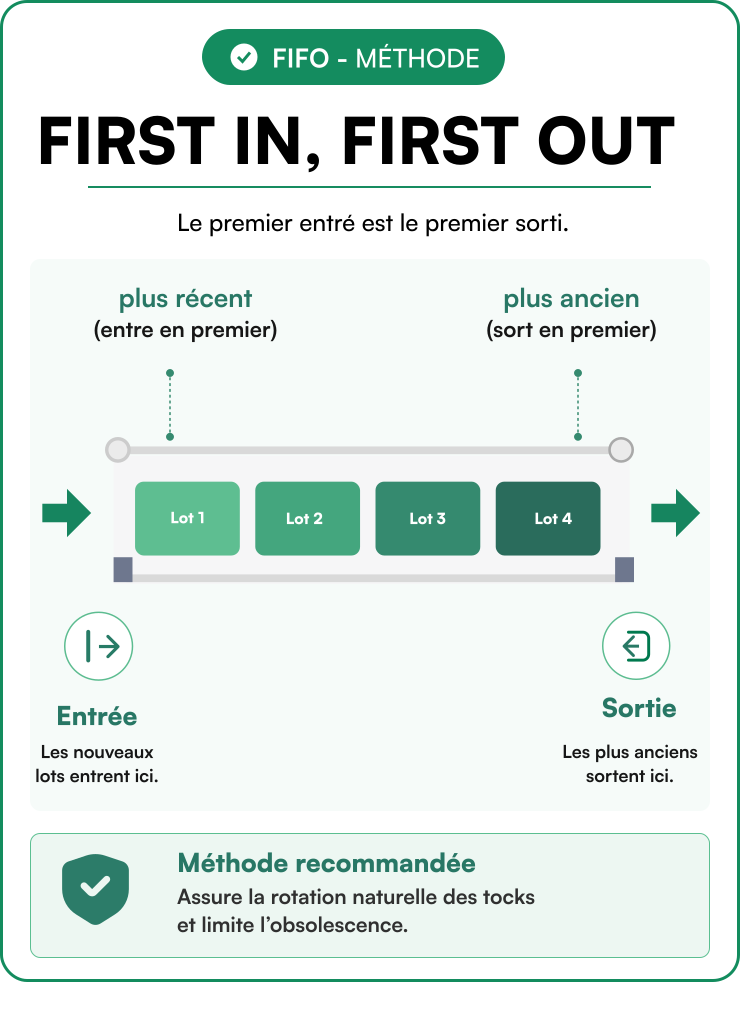
Last In, First Out
The last arrived leaves first. The default when stacking without thinking: you grab what's in front, on top, easiest to reach.
- Old lots sleeping at the back for months
- Expired shelf lives undetected
- Aged components (pharma, electronics, seals)
- Degraded traceability (mixing between deliveries)
- Direct financial losses on unusable products
First In, First Out
The first arrived leaves first. Tunnel logic: in at the back, out at the front. Guarantees chronological lot flow with no human intervention.
- Automatic chronological rotation
- Shelf lives respected with no cognitive effort
- Controlled age for sensitive components
- Per-lot traceability preserved
- Immediate view of WIP and age
FIFO or LIFO: see the difference in motion
Add and remove lots, run the automatic demo and adjust the expiry duration. You'll see why LIFO traps old lots at the back, where FIFO rotates stock in order.
Last in, first out
The last in is the first out. Old lots stay buried at the bottom of the stack.
at the top
first
3 lots stacked. Lot 1 (D-90) sits at the very bottom: already old and hard to reach.
First in, first out
The first in is the first out. Each lot crosses the queue in its arrival order.
4 lots in queue. Lot 1 (D-52), the oldest, is on the right: it's the next to leave.
What a workshop without FIFO costs
The absence of FIFO produces diffuse losses, rarely accounted for as such. Here are the 6 angles where those losses show up on the industrial sites we work with.
Expiry losses
Lots scrapped at the end of the line for expired shelf life. In food & beverage this typically represents 0.5 to 3% of materials revenue, an item rarely isolated in management accounting.
Regulatory non-compliance
In pharma, food and aerospace, failure to follow FIFO can lead to a failed customer audit, loss of certification (BRC, IFS, IATF, GMP), even product recall.
Component aging
Seals, adhesives, batteries, ESD components: their shelf life starts at production, not at use. Without FIFO, you regularly assemble aged components that fail prematurely.
Degraded traceability
Mixed lots = downstream traceability impossible to reconstruct. In case of customer complaint or recall, you no longer know which finished products contain which component lot.
Inaccurate inventories
When the actual age of stock no longer matches its ERP entry date, inventories become unreliable. Direct consequence: purchasing decisions based on bad data.
Roadblock to a future Kanban
Without controlled FIFO, it's impossible to set up a robust Kanban system: sizing relies on rotation times you don't control.
What well-implemented FIFO changes
−80%
of expiry losses
Near-immediate effect once dynamic flow racks are in place.
100%
of traceability preserved
No lot mixing, customer audits passed without heavy preparation.
−30%
of storage floor space
Gravity-fed compactness vs classic shelves with access aisles.
×2 to ×3
picking productivity
No more searching, no more handling to reach the right lot.
The least expected immediate effect: simply rolling out FIFO reveals stocks whose real age was unknown. Many sites discover 5 to 15% of their stock already expired or out of spec - a topic better discovered with the FIFO method than during a customer audit.
Setting up an effective FIFO in 4 steps
FIFO is not just a poster instruction. It's a combination of physical (supports), marking (labels) and discipline (rituals). Here is the sequence that works.
Identify the zones where FIFO is critical
Not every storage area requires strict FIFO. Prioritize references with shelf life (expiry dates), components with limited lifespan (seals, adhesives, batteries), and anything subject to customer or regulatory per-lot traceability.
Prioritization criterion: cost of loss × frequency of occurrence. A €50 component that expires once a year is less of a priority than a €5 component that expires once a month.
Deliverables
- Reference criticality matrix
- Map of stock zones concerned
- Volumes and rotation frequency per reference
- Strict / soft FIFO scope validated
Dynamic flow racks that adapt to your references
Your references evolve: new packaging, new formats, changing volumes. If your FIFO racks are rigid (welded shelves, fixed dimensions), each change costs a new project. Our modular tubular structures let FIFO breathe. From dynamic flow rack to gravity conveyor, every support reconfigures with no special tooling.
Gravity dynamic flow racks
Inclined roller shelves that ensure automatic FIFO rotation: loading at the back, picking at the front. The oldest bin naturally arrives at the picking position.
Floor FIFO lanes for pallets
Marking and signage of FIFO lanes for floor-stored pallets. Traffic direction, entry and exit positions clearly identified. Suited to high-volume, low-rotation references.
Sequenced bins and color labeling
Small-parts solutions with color-coded bin management (green/yellow/red by age). Immediate visual identification of priority lots, no need to read each label individually.
Visual lot tracking boards
Visual management boards built into the FIFO zone: current lots displayed, entry dates, status, expiry alerts. Combines operational pilot and documentary traceability.
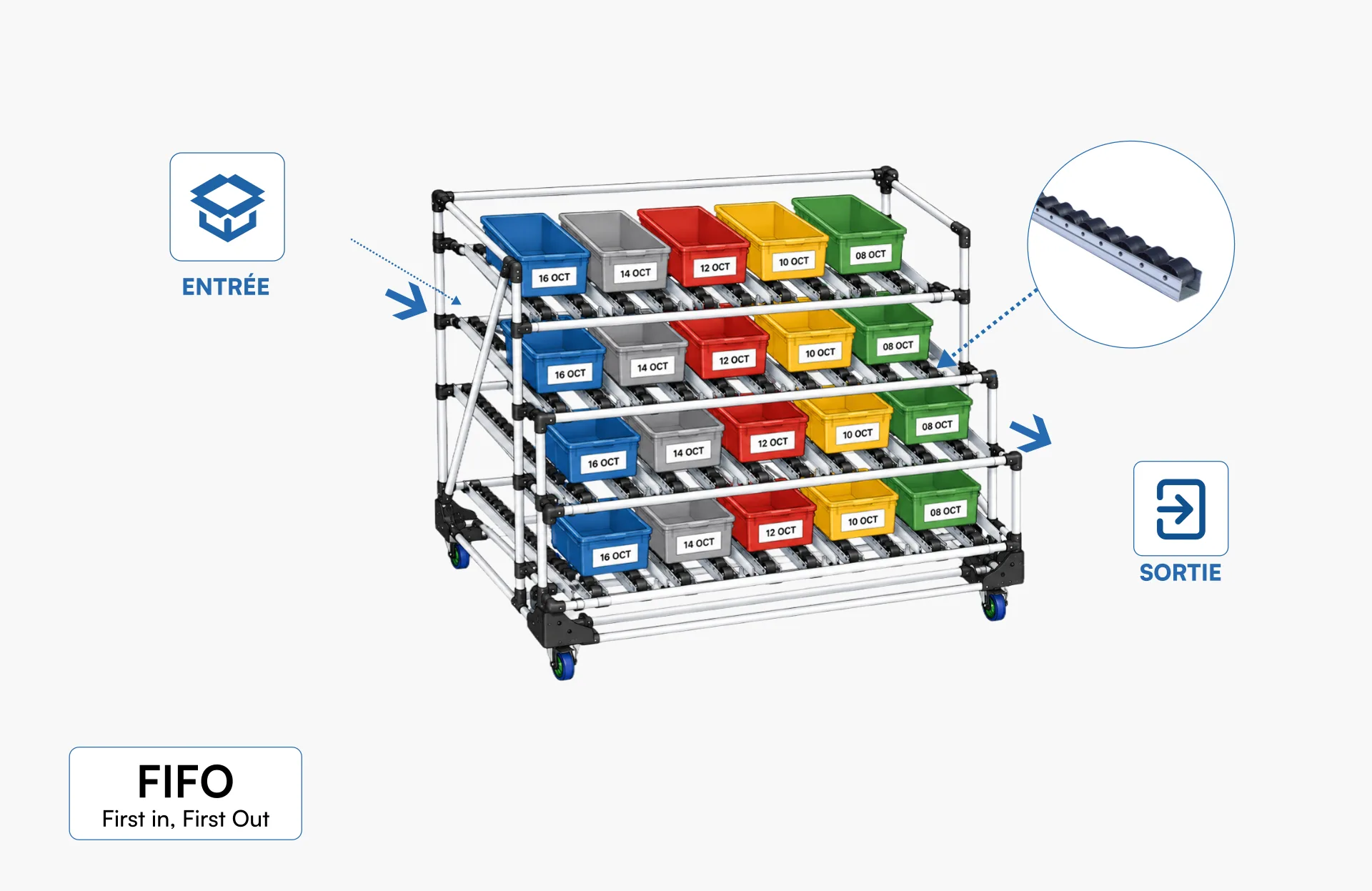
The MKL advantage: when your packaging evolves (new bin, new pallet, new format), your dynamic flow rack reconfigures in a few hours by an in-house operator. No quote, no waiting, no zone stop. A condition often overlooked but decisive for FIFO longevity.
To last over time, FIFO rests on a 5S method that structures the space and a visual management that makes lot age immediately legible.
FIFO by your industry
The rule is universal, its stakes vary. Here is how FIFO applies to the five industrial sectors we work with.
Food & beverage
Shelf life, IFS/BRC traceabilityFIFO is non-negotiable: customer requirement, IFS and BRC certifications, veterinary inspections. Applied to ingredients, food packaging, semi-finished goods. Supports compatible with bio-cleaning and humid environments.
Pharma & cosmetics
GMP, lot release, recallsFIFO mandatory in GMP environments: raw materials, packaging items, semi-finished goods. Strict per-lot labeling with entry date, quality status and reception number. Documentary support for regulatory audits.
Aerospace
Life-limited componentsCritical application on seals, adhesives, sealants, paints: all components whose lifespan begins at production. Per-unit or per-lot traceability required by EASA and FAA prime contractors.
Automotive & suppliers
IATF, per-lot traceabilityFIFO on assembled, electronic and elastomer components. Per-lot traceability conditions the ability to isolate a quality defect, a topic directly addressed by IATF 16949 audits and PPAP requirements.
Electronics & high-tech
MSL, ESD, programmed componentsFIFO on Moisture Sensitive Level (MSL) components, programmed SMD, batteries. Uncontrolled aging leads to higher in-production defect rates. ESD bins and specific labeling required.
Mechanical & subcontracting
Buffer stocks, WIPEven outside regulatory requirements, FIFO on machining and transformation WIP simplifies management: less confusion between batches, quick identification of quality drift, preparation for customer audits.
Customer case
A cosmetics contract manufacturer eliminates €95k of annual losses

Context
Cosmetics contract manufacturer, 90 employees, 4 filling lines. Raw materials and packaging items stored on classic shelves. Documented annual losses: €95k (expiry + inventory variances), tense customer audits.
Action
FIFO audit on 8 critical zones, installation of modular dynamic flow racks over 12 weeks, deployment of color labeling and the at-reception labeling procedure. Warehouse team training.
Results at 12 months
- Expiry losses−92%
- Storage floor space−25%
- Picking productivity+45%
- Customer auditpassed with no findings
What manufacturers ask us
Is FIFO always better than LIFO?
+No. LIFO can make sense in specific cases: storage of non-perishable, homogeneous materials (sand, aggregates), or when accounting considerations outweigh operational requirements. But in transformation industries with dated or traced references, FIFO is almost always the right rule.How much does FIFO deployment cost on a zone?
+Highly variable depending on volumes and support type. As an indication, a full FIFO deployment on a 100 to 200 m² storage zone (dynamic flow racks + marking + labeling + training) sits between €15,000 and €60,000. ROI is typically reached in 6 to 18 months on the reduction of expiry losses alone.Do you need an ERP or WMS to manage FIFO?
+Not necessarily. For simple storage zones, physical FIFO with manual labeling is enough in 80% of cases. ERP or WMS become useful when volumes grow (thousands of references), when documentary traceability is regulatory (pharma, aerospace), or to pilot multiple sites remotely. Pitfall: believing that a digital system replaces physical FIFO. Without physical support, the rule isn't held.What's the difference between FIFO and FEFO?
+FIFO (First In, First Out): you ship in entry order. FEFO (First Expired, First Out): you ship in expiry-date order. When lots arrive in production-chronological order, FIFO and FEFO are identical. But if a more recent lot has a shorter shelf life (e.g. close to production), FEFO is preferable. In practice, many sites implement "FIFO+FEFO": FIFO by default, FEFO when expiry dates differ between lots.Is FIFO compatible with a Kanban system?
+Not only compatible - strongly recommended. Kanban regulates flows, FIFO controls rotation. The two work together: Kanban on non-FIFO stock quickly becomes problematic because sizing relies on rotation times you don't control. Conversely, the Kanban + FIFO pair is among the most effective in Lean.How long does it take to deploy FIFO on a zone?
+From 4 to 12 weeks depending on complexity. For a simple zone with modular dynamic flow racks and standard labeling, count 4 to 6 weeks (including 1 week of effective installation). For a complex zone with hygiene/ESD/GMP constraints, design and validation can push the timeline to 10-12 weeks.Should you do a baseline audit before starting?
+Yes, and it's often the most instructive step. The pre-inventory systematically reveals dormant or expired stock no one suspected. Better to discover this internally before rolling out FIFO than during a customer audit. The baseline also conditions the right sizing of the physical supports.
MKL equipment that embodies FIFO
Without the right physical support, FIFO loses traction within weeks. Here are the solutions to deploy in front.
Dynamic flow rack
Gravity rollers: the first case in is necessarily the first case out.
DiscoverGravity conveyor
Gravity-driven transfer, zero energy, FIFO guaranteed between workstations.
DiscoverIndustrial conveyor
Paced transfers along the line, integration with tubular workstations.
DiscoverStorage rack
Modular structured storage that preserves lot order.
Discover
How much do your stock losses cost you each year?
Our simulator estimates the annual losses linked to the absence of FIFO in your situation: expiries, inventory variances, immobilized floor space. In 3 minutes you get a quantified order of magnitude.
Go further
- All Lean toolsThe complete panorama and choice guide.
- Kanban systemFIFO's natural companion for piloting flows.
- 5S methodThe organization that makes FIFO sustainable.
- Visual managementLot tracking and expiry alerts.
- Continuous improvementThe culture that evolves the system.
- Lean overviewThe fundamentals and how they connect.