Organization & standards
5S
Seiri, Seiton, Seiso, Seiketsu, Shitsuke
Method to organize and standardize the workspace in 5 steps. The foundation of any Lean initiative: without 5S, other tools don't hold.
FundamentalKick-off
See the 5S method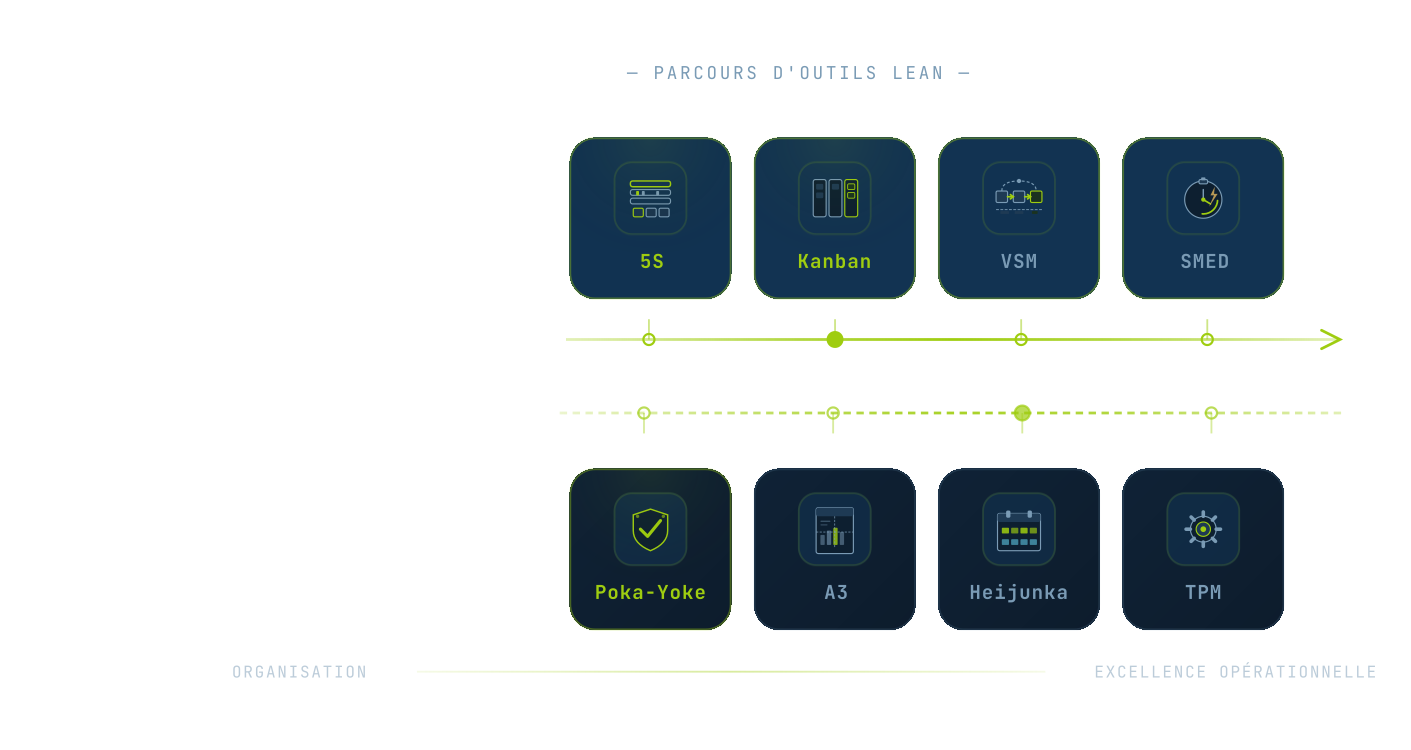
5S, Kanban, VSM, SMED, Poka-Yoke, A3, Heijunka, TPM… The Lean toolbox has dozens of methods. The real question isn't “which one to know,” it's “which one to use, for which problem, at what stage of your maturity.”
Lean Manufacturing isn't a tool, it's a continuous-improvement culture that mobilizes a structured set of methods. Every tool answers a specific problem: organize space, smooth flow, secure quality, or run performance. Deploying them in the wrong order - or all at once - is the most frequent mistake of failing initiatives.
20+
Lean tools listed
4
major usage categories
3-5
tools are enough to start
1
culture that brings them to life
Filter by category to quickly identify the tools suited to your need. Detailed pages are reachable directly from the in-depth tools.
Organization & standards
Seiri, Seiton, Seiso, Seiketsu, Shitsuke
Method to organize and standardize the workspace in 5 steps. The foundation of any Lean initiative: without 5S, other tools don't hold.
Organization & standards
Standard Work
Documentation of the best known operating method for each task: sequence, time, key quality points. The basis of continuous improvement: without a standard, no measurable progress.
Organization & standards
Error-proofing
Simple devices that make error impossible or immediately detectable: asymmetric part shape, presence sensor, automatic cross-check. Quality by design.
Flow & logistics
Card / signal
Pull-flow control system: you only produce what has just been consumed. Cuts WIP by 30 to 50%, eliminates internal stockouts, releases working capital.
Flow & logistics
Value Stream Mapping
Mapping of the value stream: full visualization of operations, stocks, cycle times, from supplier to customer. Essential diagnostic tool before any Lean deployment.
Flow & logistics
First In, First Out
Management rule that guarantees stock flows in arrival order. Critical for traceability, food shelf life, and component aging control.
Flow & logistics
Single-Minute Exchange of Die
Method to reduce changeover times. Goal: go from a > 10-min change to < 10 min (Single Minute = single digit). Enables smaller batch production.
Flow & logistics
Production leveling
Leveling product mix and volume over the period to absorb demand variations without shop floor jolts. The condition of a stable Kanban and a held takt time.
Flow & logistics
Milk run / small train
Pickup and delivery route at a defined frequency between central store and production stations. Replaces anarchic unit transfers with a paced, predictable flow.
Quality & problem solving
5 Why Analysis
Simple root-cause method: ask “why” 5 times until you reach the underlying problem. Basic tool of any field problem-solving process.
Quality & problem solving
Structured problem-solving method
Single A3-sheet format to structure problem solving: context, current state, goal, analysis, countermeasures, plan, follow-up. The Toyota standard.
Quality & problem solving
Plan, Do, Check, Act
Deming's continuous-improvement cycle. Every improvement action goes through these 4 phases: plan, execute, check, anchor or adjust. Lean's grammar.
Quality & problem solving
Fishbone / 5M
Graphical representation of possible causes of a problem, classified in 5 families (Material, Method, Milieu, Manpower, Machine). Structured brainstorming tool.
Quality & problem solving
Autonomation
A machine's or operator's capability to automatically stop the process on defect. Prevents defect propagation and forces handling the cause at the source.
Performance & pilot
Visual Management
All devices that make performance and gaps visible to everyone, on the shop floor. Huddle boards, andon, shop-floor KPIs. The nervous system of the Lean workshop.
Performance & pilot
Overall Equipment Effectiveness
Composite indicator of equipment performance: Availability × Performance × Quality. The universal KPI of workshops: between 60% (standard industry) and 85% (world class).
Performance & pilot
Total Productive Maintenance
Global approach involving operators in the daily maintenance of their equipment. Includes autonomous, preventive maintenance, and continuous reliability improvement.
Performance & pilot
Field tour
Regular management tour of the shop floor to observe, ask questions, support the team. The opposite of “from the desk” management: the basis of Lean leadership.
Performance & pilot
Strategic deployment
Method to cascade management's strategic priorities down to field teams, via a cascade of aligned goals. The connection between long-term vision and daily action.
Performance & pilot
Continuous improvement
Philosophy of small daily progress, by small teams, on the field. Often embodied in “Kaizen workshops” of 3 to 5 days on a precise scope.
The classic mistake: trying to deploy everything at once. Lean maturity is built in layers: a workshop that doesn't have its 5S in place won't hold a robust Kanban, and a Kanban without visual management has no one to animate it. Sequence matters as much as the tools.
Identify the Lean tool(s) suited to your situation by clicking on the matching situation. The result points you to the relevant tool and its usage context.
My main problem today:
Select the situation that best matches your current context.
Lean maturity is built in successive layers. Here is the recommended progression for an SME or industrial site starting its journey, validated by dozens of deployments observed on the field.
0-2 months
2-3 months
3-6 months
6+ months
This progression isn't rigid. Depending on your starting point, sector and constraints, some steps can be parallelized or reordered. The invariant principle: do not start the next phase before having solidly anchored the previous one.
Whatever Lean tool you deploy, they share one thing: it will evolve. Your 5S boards will be moved, your Kanban boards resized, your FIFO zones reorganized, your standards updated. If your physical supports don't follow, the entire initiative seizes up.
Makitlean modular tubular structures are designed precisely for this context: every support needed for your Lean deployment, configurable and reconfigurable endlessly, with no welding or cutting.
Custom 5S and visual management boards
Modular Kanban boards (launchers and receivers)
Gravity dynamic flow racks for FIFO
Evolving ergonomic workstations
Configurable transfer trolleys and milk runs
Heijunka boxes and sequencing supports
Every Lean tool needs its physical support. Here are the ones we make.
Visual control: Kanban, visual management, PDCA tracking.
Discover5S at the workstation: instantly legible storage.
DiscoverFIFO and pull flow embodied line-side.
DiscoverGravity-driven transfer: zero energy, FIFO guaranteed.
DiscoverOur ROI simulator estimates, on your situation, which of these tools would bring the fastest gain. In 3 minutes you get a quantified prioritization of potential gains per tool.