Continuous improvement: the system that transforms the workshop month after month
Continuous improvement isn't a philosophy you display, it's an operational system you install: rituals, structured methods, visible indicators, supports that evolve. Culture comes afterward, as a consequence of the results obtained, not as a prerequisite.
What continuous improvement is not
Too many manufacturers associate continuous improvement with fuzzy concepts, motivational posters or team seminars. Here's what it really is.
Common belief
“It's a philosophy from Japan”
Quoting Toyota would be enough to make the workshop progress. Culture would precede action.
Field reality
It's a system with dated rituals
The daily 8:05 huddle, the Thursday weekly review, the monthly Kaizen workshop. Without cadence, nothing holds.
Common belief
“You have to change the culture first”
Launch a big communication, train everyone, wait for mindsets to evolve.
Field reality
Culture follows results
Start with 1 project that proves a measurable gain. Culture emerges from the repetition of visible successes.
Common belief
“It's the Lean department's job”
A continuous-improvement manager (or an outside consultant) carries the initiative on behalf of the plant.
Field reality
It's the operators' job
Improvements that last come from the field. The Lean department facilitates, management protects, the field produces the ideas.
Common belief
“You have to aim for big breakthroughs”
Massive investment, line transformation, a 6-month project to revolutionize production.
Field reality
It's the small gains that add up
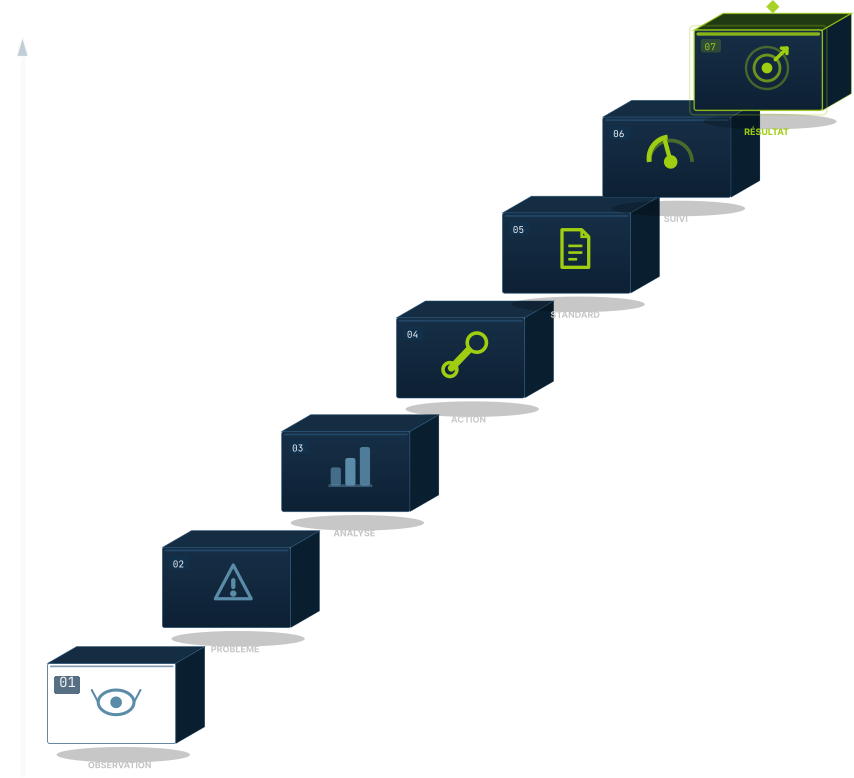
1% improvement per month = 12.7% per year = 70% in 5 years. Nobody sees the step, everyone sees the staircase.
Continuous improvement: a structured approach, not a state of mind
Continuous improvement (in Japanese: Kaizen) is an organized system of permanent progress, founded on direct shop-floor team involvement and a rigorous methodological cycle: PDCA. It contrasts with the logic of big top-down projects and favors incremental, measurable advances anchored in updated standards.
The conceptual pitfall: many continuous-improvement initiatives fail because they try to build a culture before installing a system. The opposite works. Install the rituals, the tools and the indicators first; culture will emerge by contamination.
PDCA: the universal grammar of improvement
Every continuous-improvement action, whether it lasts 30 minutes or 3 months, follows the same 4-phase cycle: Plan, Do, Check, Act. Click on each quadrant for operational detail.
Phase 1
Plan
Describe the problem in factual data. Identify root cause via 5 Whys or Ishikawa. Set a quantified target and the success criterion. Design the countermeasure.
Typical deliverables
- Quantified description of the gap
- Root-cause analysis
- SMART target to achieve
- Action plan with owner and deadline
PDCA is recursive. Each phase itself contains its own PDCA cycle. And each completed cycle becomes the starting point of the next, hence the image of the wheel turning while climbing. Without Act, the cycle stops and improvement doesn't hold. It's the most frequent mistake on the shop floor.
3 improvement project formats
Depending on problem scope and perimeter, continuous improvement takes three main formats. All follow PDCA logic, but with different durations and intensities.
Format 1: short
Daily quick win
Coming from the morning huddle, handled during the day by the team. Small one-off problem: a misplaced label, a missing tool, a sign to change. No heavy method.
- Duration
- 1 day or less
- Team
- 1 to 3 shop-floor people
- Frequency
- Several per week
- Format
- Quick note on the huddle board
Format 2: medium
5-day Kaizen workshop
Classic Toyota format: a multi-disciplinary team blocks 5 days to solve a targeted problem. Monday diagnostic, Tuesday-Thursday implementation, Friday standardization and communication.
- Duration
- 3 to 5 days
- Team
- 4 to 8 people (field + cross-functional)
- Frequency
- 1 to 2 per month
- Format
- A3 method + on-site workshop
Format 3: long
Improvement project
For cross-cutting topics beyond a workshop's autonomy: flow redesign, Kanban deployment, full-workshop 5S. Project management with regular milestones.
- Duration
- 1 to 6 months
- Team
- Dedicated project team
- Frequency
- 2 to 4 projects in parallel
- Format
- Specs + milestones + steering committee
What a continuous-improvement initiative produces
+12.7%
compound annual gain
At 1% improvement per month, the minimum of a structured system.
×3 to ×5
improvement ideas captured
When the field has a structured channel to propose and see them through.
−25%
recurrence of problems
PDCA addresses the root cause, not the symptom.
−40%
turnover on pilot sites
Operators involved in improvement stay.
Beyond the numbers
Transformed engagement. Seeing your ideas taken into account and applied radically changes your relationship to work.
Stronger collective capability. The organization learns to solve on its own the problems it encounters.
Easier onboarding. Newcomers understand that standards evolve and that they can evolve them.
Strengthened customer audits. A formalized continuous-improvement approach is a commercial and certification asset.
Increased resilience. The organization better absorbs crises (material shortage, absenteeism, demand surge).
Employer attractiveness. Sites where the shop floor has the lead attract qualified profiles in the sector.
The 4 rituals that bring the approach to life
Without cadence, continuous improvement dies in 3 months. Here are the 4 minimum rituals to put in place so the system runs autonomously.
Daily
Team huddle
10-15 min, standing in front of the visual board. Yesterday's performance, issues, top 3 actions of the day.
Weekly
Project review
30-45 min, status of ongoing PDCAs, unblocking, launching of new projects.
Monthly
Improvement committee
1h-1h30, recap of realized gains, prioritization of next topics, sharing between teams.
Quarterly
Management review
2h, alignment with site strategy, standards review, celebration of wins.
5 conditions for an initiative to hold over time
80% of continuous-improvement initiatives launched in French SMEs lose steam within 18 months. The 20% that last share these 5 conditions.
01
Management commitment
Management visits the field (Gemba Walk), takes part in rituals, unblocks requested resources. Without visible support, the field quickly understands the initiative is cosmetic.
Failure signal: management talks about continuous improvement in meetings but never attends the shop-floor huddle.
02
Visible, up-to-date standards
Without a displayed standard, you can't measure deviation. Without updates, improvement doesn't anchor. The standard isn't a constraint, it's the basis on which you progress.
Failure signal: the standards are 3 years old and no one knows where to find them.
03
Shared, legible indicators
You don't run what you don't measure. Visual management makes indicators accessible to everyone, in real time, on the shop floor.
Failure signal: the KPIs are in an Excel file consulted once a month in a meeting.
04
Physical modification capability
An idea that takes 2 months to implement dies. Workstations, boards, supports must be modifiable by the field in a few hours, not by an outside provider over several weeks.
Failure signal: every workstation modification requires a quote and 6 weeks of waiting.
05
Recognition of contributions
Operators who propose ideas must see their ideas succeed, be named, celebrated. No need for a financial bonus: public recognition is enough, provided it's regular and sincere.
Failure signal: ideas go into a suggestion box no one cares about.
Modularity as a technical condition of continuous improvement
A truth rarely read in Lean literature: the physical capability to modify the workshop conditions the vitality of continuous improvement. If every evolution costs a project, a quote, a delay, the system seizes up regardless of method quality.
Why your physical supports make the difference
All the methods in the world are useless if your installations don't follow. Continuous improvement requires that the physical organization of the workshop can evolve as fast as the ideas that emerge.
“A continuous-improvement initiative is a succession of modifications. Each modification not feasible quickly is an idea that dies.”
Makitlean modular tubular structures let your workshop breathe at the rhythm of your initiative.
Workstation modification in less than 30 minutes
No welding, no cutting, no outside provider
100% component reuse at each evolution
Adaptation to new standards without reinvestment
Rapid prototyping capability to test before industrializing
Visual coherence preserved across the entire workshop
Continuous improvement by your industry
The principles stay constant, the playing fields change. Here are the most fruitful angles of continuous improvement across five sectors we work with.
Automotive & suppliers
PPM, takt time, fast changeoversApproach structured by IATF requirements: quality reviews, 8D structured problem solving, SMED workshops. High-performing sites industrialize one PDCA per workstation per month.
Food & beverage
Hygiene, yield, changeoversFocus on material yields, cleaning times and changeovers. Short Kaizen workshops (3 days) between two batches work particularly well.
Aerospace
Conformity, traceability, FAIContinuous improvement often integrated into non-conformities: every documented gap triggers a structured PDCA. The A3 format is the sector standard.
Pharma & cosmetics
GMP, deviations, lot releaseThe GMP framework already enforces a culture of documentation and traceability. Continuous improvement capitalizes on this base to systematically address recurring deviations.
Electronics & high-tech
FPY, rework, process controlElectronics workshops are rich in usable process data. Continuous improvement leans on statistical analysis (SPC) to target the highest-impact projects.
Multi-sector SMEs
Start small, prove fastFor SMEs, the classic pitfall is over-formalization. The rule that works: start with 3 Kaizen workshops over 6 months, prove the gains, scale by natural contagion.
Customer case
A mechanical SME transforms its workshop in 18 months
Context
Mechanical SME, 75 employees, 3 machining workshops. No structured approach, ignored improvement ideas, operator turnover at 22%, average OEE 64%, 3 customer complaints per month.
Action
Daily huddle put in place, training of 12 team leads on PDCA and A3, launch of 8 Kaizen workshops over 12 months, installation of modular boards and workstations enabling on-field modifications.
Results at 18 months
- Site OEE64% → 78%
- Customer complaints−65%
- Operator turnover22% → 9%
- Ideas raised per month×6
What manufacturers ask us
How long until you see first results?
+Quick wins from the daily huddle produce visible results in 2 to 4 weeks. The first structured Kaizen project delivers its quantified gains in 5 days. Cultural effects (engagement, autonomy) settle in 6 to 12 months. A well-launched initiative shows ROI in less than 6 months.Do you need a dedicated continuous-improvement manager?
+For an SME of < 50 people: no, it's the director's or production manager's role. Between 50 and 200: a part-time coordinator is enough. Beyond that: a dedicated role becomes relevant. Pitfall: creating a “Lean manager” position who becomes the sole owner, which removes responsibility from management.How do you handle reluctant operators?
+Resistance almost always comes from bad past experiences: abandoned initiatives, ignored ideas, increased workload. Don't try to convince verbally. Start small, prove the gains, let the results speak. The reluctant ones convert by seeing their colleagues gain time and recognition.Should 5S be deployed before continuous improvement?
+Not mandatory, but strongly advised. The 5S method creates the physical environment in which continuous improvement becomes visible and manageable. In practice, many sites roll out both in parallel on the same pilot zone, 5S often being the first Kaizen workshop.What's the difference between Kaizen and continuous improvement?
+Kaizen is the Japanese word for continuous improvement (“good change”). In French practice, “Kaizen” often refers to a specific format: the 3- to 5-day workshop bringing a cross-functional team together on a targeted problem. Continuous improvement is the whole system that contains Kaizen workshops, plus the huddles, plus the rituals, plus the standards.How do you measure the ROI of a continuous-improvement initiative?
+Three measurement levels: (1) direct project gains, quantified at the end of each PDCA; (2) evolution of site KPIs (OEE, quality, working capital, turnover); (3) self-resolution capability (number of issues handled without cross-functional intervention). Total ROI is observed over 12-18 months and typically reaches 5 to 15× the initial investment.Can you start without a training budget?
+Yes, provided you're lucid about the first months. Free resources (books, videos, feedback from other manufacturers) are enough to understand the basics of PDCA and A3. Training becomes indispensable to anchor sustainably, especially the animator roles. Count €500 to €1,500 per team lead for an operational training.
The supports that make a continuous-improvement initiative last
A PDCA only survives if the workshop can evolve without starting from scratch. Here are the associated modular building blocks.
How much does each month without a structured approach cost you?
Our simulator estimates the monthly cost of the absence of continuous improvement: recurring problems, uncaptured ideas, unrealized productivity gains. In 3 minutes you get a quantified order of magnitude for your situation.
Go further
- All Lean toolsThe complete panorama and choice guide.
- 5S methodThe organizational foundation of the initiative.
- Visual managementThe system that makes gaps visible.
- Kanban systemThe flow control that reveals possible improvements.
- FIFO methodControlled stock rotation.
- Lean overviewThe fundamentals and how they connect.